
November 05, 2026 | Blog, Facelift
6 minute read
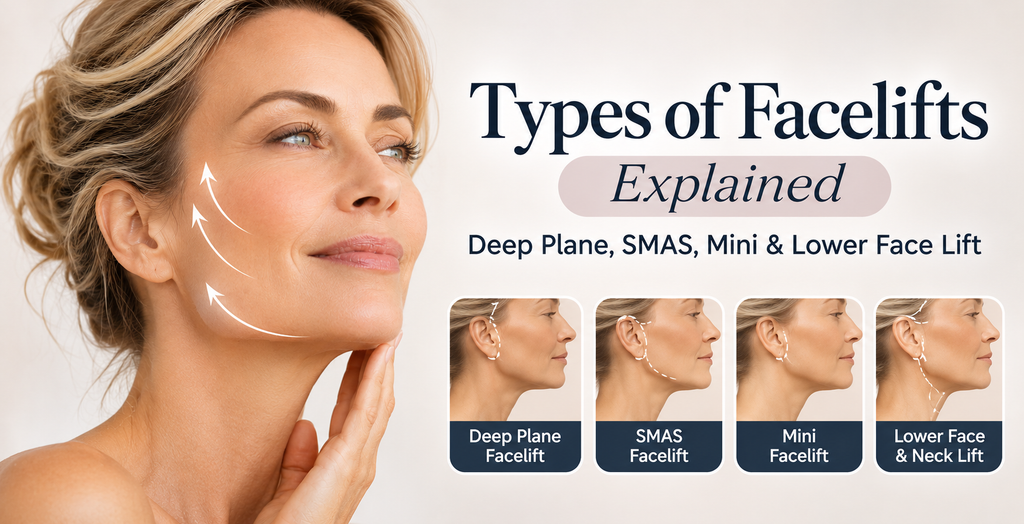
The main types of facelifts are the SMAS facelift, the deep plane facelift, the mini facelift and the lower face and neck lift. They differ in which tissue layer the surgeon works on, how long the incisions are, and how much of the face and neck they address. The right type depends on your anatomy, your degree of laxity and your goals, which is why a consultation matters more than the name of the technique.
This guide explains how each type of facelift works and who it may suit.
Why there is more than one type of facelift
As we age, the skin loses elasticity, fat pads in the cheeks descend, and the supporting layers underneath loosen. The result is often jowls, deeper folds between the nose and mouth, and loose skin or banding in the neck.
The key structure in most facelifts is the SMAS (superficial musculoaponeurotic system). This is a layer of connective tissue and muscle beneath the skin and fat that supports the lower two-thirds of the face. Modern facelifts work on this deeper layer, not just the skin. Lifting the skin alone tends to give a pulled look and less durable results.
The main difference between facelift types is how the surgeon treats the SMAS and the ligaments that hold the face in place.
Types of facelifts compared
| Type | Best suited to | Tissue layer | Typical incisions | Typical downtime* |
|---|---|---|---|---|
| SMAS facelift | Moderate laxity in the lower face and jowls | SMAS is tightened or repositioned; skin is lifted separately | In front of and around the ear, into the hairline | About 2–3 weeks |
| Deep plane facelift | Moderate to significant laxity in the midface, jowls and neck | Surgeon works beneath the SMAS and releases retaining ligaments; skin and SMAS move together | In front of and around the ear, into the hairline | About 2–4 weeks |
| Mini facelift | Early, mild to moderate jowling with good skin quality | Limited SMAS tightening through a smaller access area | Shorter incisions around the ear | About 1–2 weeks |
| Lower face and neck lift | Jowls, a blurred jawline and loose neck skin or bands | SMAS and the neck muscle (platysma) | Around the ear, often with a small incision under the chin | About 2–3 weeks |
*Downtime ranges are typical estimates only. Recovery varies with the extent of surgery, combined procedures and individual healing.
SMAS facelift
In an SMAS facelift, the surgeon lifts the skin, then tightens or repositions the SMAS layer beneath it, often by folding (plication) or trimming and suturing it (SMASectomy). The skin is then redraped and excess is removed.
May suit you if: you have moderate jowling and lower-face laxity, and your midface has not descended significantly.
Things to know: the SMAS facelift has been used for decades, and there are many variations. Because the skin and SMAS are handled as separate layers, results depend on careful planning to avoid tension on the skin.
Deep plane facelift
In a deep plane facelift, the surgeon works in the plane beneath the SMAS and releases the retaining ligaments that tether the tissues. The skin, fat and SMAS are then repositioned together as one unit.
May suit you if: you have laxity in the midface, the lines from the nose to the mouth, the jowls and the neck, and you want a repositioning of the deeper tissues.
Things to know: deep plane surgery is technically detailed because it works closer to branches of the facial nerve, so surgeon training and experience matter. Swelling can last longer for some patients. It is not automatically the right choice for everyone. Read our deep plane vs. SMAS comparison for a closer look.
Mini facelift
A mini facelift uses shorter incisions and a more limited lift, usually focused on early jowling along the jawline.
May suit you if: you have mild to moderate sagging, good skin elasticity and little loose skin in the neck.
Things to know: recovery is often shorter than for a full facelift. Because less tissue is treated, a mini facelift will not address significant neck laxity or midface descent, and the change is more subtle.
Lower face and neck lift
A lower face lift targets the jowls and jawline. It is often combined with a neck lift, which tightens the platysma muscle and removes excess skin and, where appropriate, fat under the chin.
May suit you if: your main concerns are jowls, a less defined jawline, loose neck skin or visible neck bands.
Things to know: a small incision under the chin may be needed to tighten the neck muscles. Many patients find the neck is the area that bothers them most, so combining the two is common.
What about non-surgical options?
Non-surgical treatments cannot reposition deeper tissues the way surgery can, but they may help people with early changes or those who are not ready for surgery. Options at our practice include Morpheus8, Ultherapy, PDO thread lifts and dermal fillers (sometimes called a “liquid facelift”). Results are more modest and usually need maintenance. They also carry their own risks, which your provider should explain.
How to choose the right type of facelift
The right technique depends on your anatomy, not on which name sounds most advanced. At a consultation, your surgeon will typically assess:
- Where the laxity is: midface, jowls, neck, or a combination
- Skin quality: thickness, elasticity and sun damage
- Bone structure and fat distribution
- Your health: medical conditions, medications and smoking status
- Your goals and recovery time: how much change you want and how long you can take off
You should also ask about the surgeon’s training, how often they perform the technique they recommend, its specific risks, and what recovery will look like for you.
Risks to be aware of
All facelift types are surgery and carry risks. These include bleeding or hematoma, infection, scarring, changes in skin sensation, hair loss near incisions, asymmetry, skin healing problems (more likely in smokers), injury to facial nerves (usually temporary, rarely permanent) and risks related to anesthesia. Your surgeon should explain how these apply to the technique recommended for you.
Find the right facelift technique for you
No single facelift type is best for everyone. Dr. Greenberg’s team offers SMAS, deep plane, mini and lower face and neck lift techniques, and will recommend an approach based on your assessment.
Learn more about our facelift procedure in New York, or request a consultation to talk through your options.
Medical disclaimer: This article is for general information only and is not medical advice. Results and recovery vary from person to person. Every surgery carries risks. Please consult a qualified, board-certified plastic surgeon about your individual situation.