
November 09, 2026 | Blog, Facelift
5 minute read
Medically reviewed by Stephen T. Greenberg MD, FACS · Greenberg Cosmetic Surgery
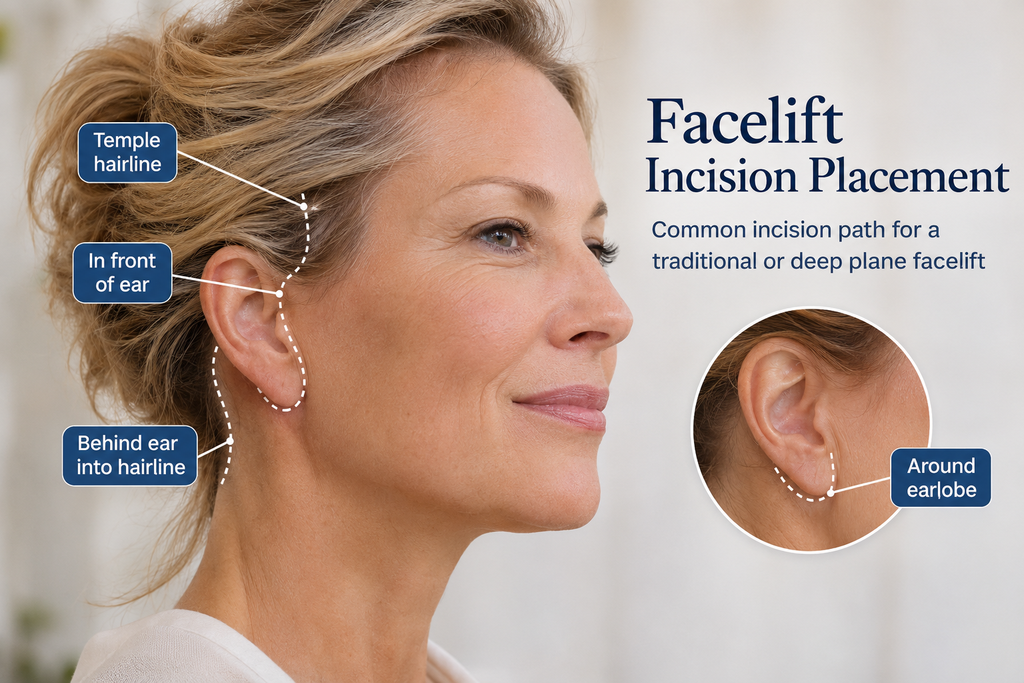
Facelift scars usually sit in the hairline at the temple, run along the natural crease in front of the ear, curve around or behind the earlobe, and end in the hairline or crease behind the ear. Surgeons choose these paths because they follow natural contours and are easy to conceal. All surgery leaves a scar, but for most patients facelift scars fade over 12 to 18 months and become hard to notice.
Here is where incisions go for each type of facelift, how they heal and what you can do to help.
Where facelift incisions are placed
The exact incision depends on your anatomy, the technique and how much tissue needs repositioning. Your surgeon will mark and explain your incision plan before surgery.
| Technique | Typical incision path | Best suited to |
|---|---|---|
| Traditional or deep plane facelift | Temple hairline, front of the ear, around the earlobe, behind the ear into the hairline | Moderate to significant sagging of the cheeks, jowls and neck |
| Mini facelift | Shorter incision, mainly in front of the ear, with a limited extension | Mild to moderate sagging along the jawline |
| Neck lift (alone or combined) | Behind the ear, often with a small incision under the chin | Loose neck skin and muscle bands |
Why these locations help scars stay discreet
- Natural creases. The line where the ear meets the cheek is a natural shadow, so a fine scar there blends in.
- Inside the ear contour. In many women, the incision can follow the edge of the small cartilage flap at the front of the ear (the tragus), which further hides it.
- Within or along the hairline. Hair covers scars in the temple and behind the ear. Your surgeon will plan the incision so your hairline and sideburn stay as natural as possible.
- Low tension. Modern techniques lift the deeper tissue layers rather than pulling the skin tight. Less tension on the skin edges generally means a finer scar.
The facelift scar healing timeline
Everyone heals differently, and your surgeon’s instructions take priority. As a general guide:
| Time after surgery | What incisions typically look like |
|---|---|
| Week 1 | Incisions are closed with sutures or staples and may be covered. Mild crusting, redness and swelling are normal. Some sutures are removed around the end of the first week. |
| Weeks 2–3 | Remaining sutures or staples are usually removed. Incisions are pink and slightly raised, and makeup can often be used to cover them once your surgeon approves. |
| Months 1–3 | Scars may look pinker or firmer before they improve. This is a normal part of healing. |
| Months 3–6 | Redness fades and scars begin to flatten and soften. |
| Months 12–18 | Most scars have matured into fine, pale lines that blend with the surrounding skin. |
What affects how your facelift scars heal
- Smoking and nicotine. Nicotine narrows blood vessels and raises the risk of poor wound healing and skin loss. Most surgeons ask patients to stop all nicotine products for several weeks before and after surgery.
- Sun exposure. UV light can darken healing scars, sometimes permanently.
- Genetics and skin type. Some people are prone to raised (hypertrophic) or keloid scars. Tell your surgeon about any past scarring problems.
- Tension and movement. Avoid heavy lifting, bending and strenuous exercise until cleared, since strain can widen scars.
- Infection or wound problems. Following wound-care instructions closely lowers this risk.
How to care for facelift scars
- Keep incisions clean exactly as your surgeon instructs, and do not pick at scabs.
- Protect scars from the sun with a hat and, once incisions are fully closed, a broad-spectrum sunscreen of SPF 30 or higher for at least a year.
- Ask about silicone gel or sheets. Many surgeons recommend silicone once the incisions have closed, as it can help scars flatten and fade.
- Massage only if advised. Gentle scar massage may be suggested a few weeks after surgery.
- Avoid nicotine and alcohol during healing.
- Keep follow-up appointments so your surgeon can check healing and treat any raised scars early.
What if a scar does not heal well?
A small number of patients develop scars that stay raised, widen or change color. Options may include steroid injections, laser treatment, microneedling or, occasionally, a minor scar revision. These are usually considered once the scar has had time to mature. Hair loss along an incision near the temple can also occur and is often temporary.
Frequently asked questions
Are facelift scars visible? In the first weeks they are visible up close, especially in front of the ear. Once mature, most facelift scars are fine and pale, and many are hidden by hair or the natural contours of the ear.
Can you have a facelift without scars? No. Every surgical facelift leaves scars. Non-surgical treatments such as Ultherapy or a PDO thread lift avoid incisions, but their results are more modest and shorter-lived.
Can I wear my hair up after a facelift? Once scars have matured, many patients wear their hair up comfortably. Ask your surgeon how your incision plan affects your hairline and sideburns.
When can I wear makeup over facelift scars? Usually once the incisions are fully closed and your surgeon approves, often in the second or third week.
See real patient results
Incision placement and healing are easiest to understand by seeing results from real patients at different stages. View our facelift before-and-after gallery, or book a consultation to discuss your incision plan with one of our board-certified plastic surgeons. Individual results vary.
This article is for general educational purposes and is not medical advice. Individual results and recovery vary. A consultation with a board-certified plastic surgeon is needed to discuss your candidacy, risks and expected outcome.